Should You Invest in AI? The Dark Side Nobody Is Talking About
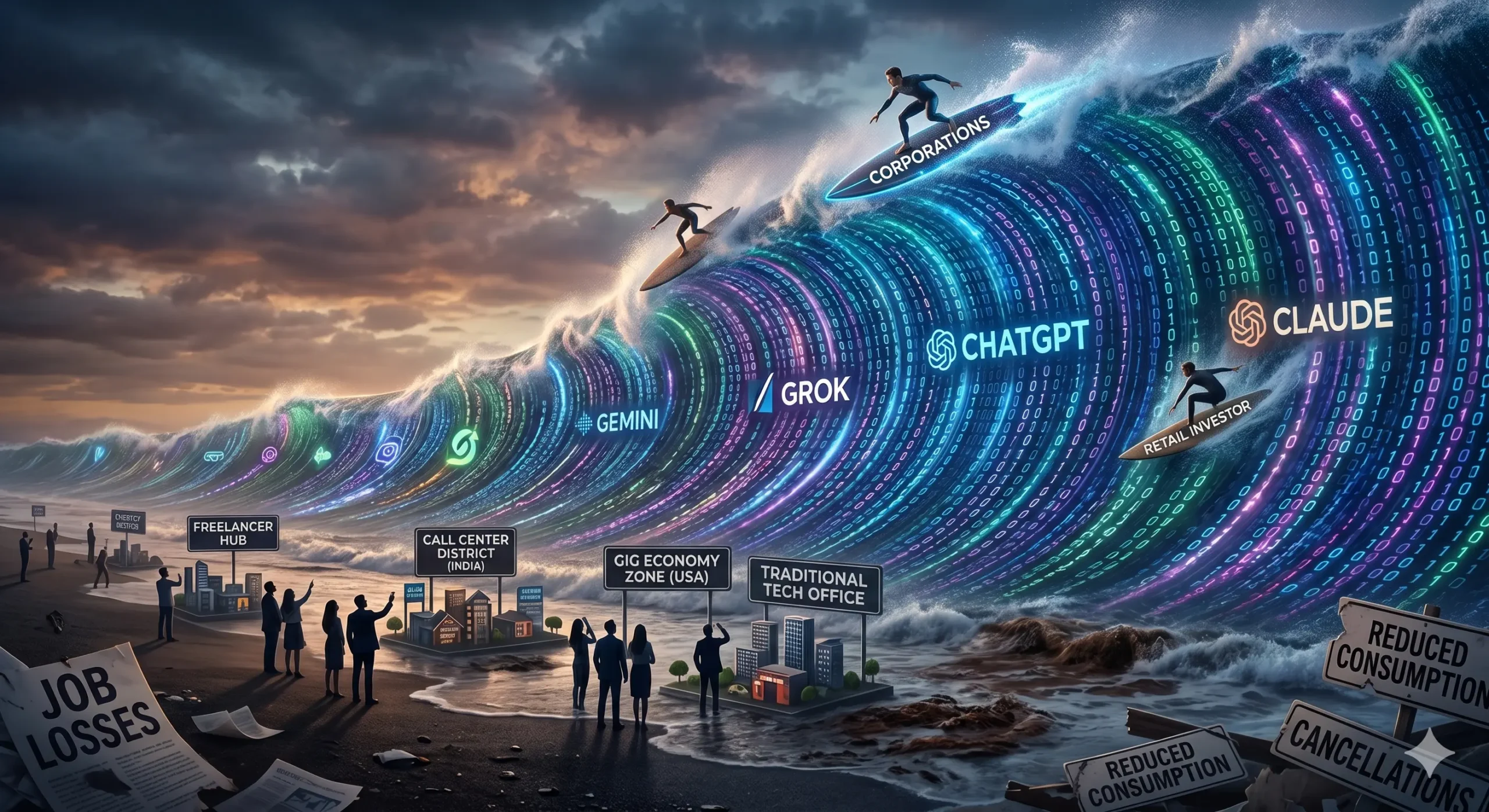
The question I get asked most often lately is: “Should I invest in AI?” It’s easy to see why. We are witnessing a massive shift. Gemini, Grok, ChatGPT, and Claude are no longer just toys; they are tools doing complex tasks in seconds. On the surface, the “efficiency” story is incredible:
- Small Businesses: A company that once paid a freelancer ₹20,000/month for social media now pays ₹2,000 for an AI subscription.
- Tech Teams: Projects that required 10 engineers a few years ago are now run just as efficiently by a team of three.
- Call Centres: Large-scale lending companies are replacing thousands of human callers with AI automated systems, aiming to cut headcount by 80%.
- The Gig Economy: In the US, Waymo (Google) is already running driverless taxis, and Tesla is inching closer to full autonomous driving approval.
From a corporate balance sheet perspective, this is a dream. Billions in savings, skyrocketing revenues for AI providers, and a massive boom in data centres. It looks like the ultimate investment.
BUT… There is a Dark Side.
While the “efficiency” is being celebrated, no one is talking about the systemic collapse of consumption.
Let’s look at the real-world impact of those “savings”:
- The Freelance Struggle: When small companies stop hiring freelancers, those freelancers lose their income. Their spending drops. They stop buying their own AI subscriptions because they are fighting for survival.
- White-Collar Layoffs: Tech workers are being laid off at a record pace. Finding a new role is harder, and many are forced to take lower-paying jobs. When your salary is cut or gone, your consumption—and your premium subscriptions—are the first things to go.
- The BPO Crisis: India’s massive call centre industry is a pillar of employment. If these jobs become redundant in the next few years, millions of people will see their purchasing power vanish.
- The Gig Worker Collapse: In the US, millions rely on driving and delivery. If AI takes the wheel, these families can’t put kids through college or buy goods.
The Consumption Paradox
Here is the part the “AI Bulls” miss: If people lose their jobs, who is going to buy the products AI is making?
If the middle class is hollowed out, Netflix subscriptions get cancelled. iPhone sales drop. Amazon deliveries slow down. Brands stop spending on YouTube and Instagram because no one is buying. Even Microsoft Office and Windows subscriptions decline as companies shrink their headcounts.
When AI peaks, we shouldn’t just worry about a market correction—we should worry about a Great Depression similar to what the US saw from 1929 to 1939. If the “efficiency” leads to a total collapse in global consumption, FAANG revenues and government tax collections will follow it down.
My Advice: Don’t Chase the Trend
Investing in specific AI “stars” right now is incredibly risky. Very few companies will actually survive the long-term economic downturn that AI might trigger.
If you still want exposure to the US market, diversification is your only shield.
- Stick to ETFs: Instead of betting on a single “hot” AI stock, look at the NASDAQ 100 or the S&P 500.
- The Simpler Way: For Indian investors, Parag Parikh’s GIFT City fund offers a streamlined way to invest (with as little as $5,000) into a collection of global companies. These are established businesses that are more likely to weather a transition than a specific AI or Data Centre related company.
Invest in a good multicap or flexicap fund with a more than 10-15 year horizon along with the above and it will solve for majority of your goals.
Never invest in trends. They always fade, and retail investors are usually the ones trapped at the peak. Past 5 years we already seen a lot of people trapped in trends, recent one was people investing in Silver.
Investing should be boring. And boring is what makes money.
If you have a contrarian view, I’d love to hear it. If you have any questions about how to position your portfolio for this shift, feel free to reach out to me.